

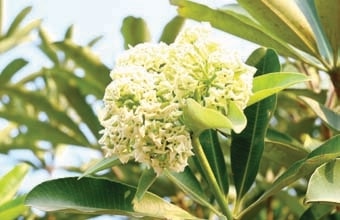
When a mysterious fragrance announces Delhi’s favourite season.
On an October evening in Delhi, when the city hums with traffic, hurried footsteps, and fading sunlight, a sudden fragrance slices through the familiar chaos. Strong, sharp, and strangely irresistible, it wraps itself around passersby—hovering for a moment before disappearing, only to return with the next whisper of wind. It is a scent that marks a shift, a reminder, a quiet declaration that winter is on its way.
This intoxicating perfume belongs to Alstonia scholaris—known variously as the Scholar Tree, Saptparni, or, in its more dramatic avatar, the Indian Devil Tree. With clusters of delicate, funnel-shaped white blossoms set against glossy evergreen leaves, the tree stands tall across Delhi’s parks, avenues, and colonial neighbourhoods. For those living in the leafy lanes of Lutyens’ Delhi, its fragrance often drifts into verandahs and courtyards, becoming the first sensory signal of the season’s change.
Native to the Indo-Malayan region, the tree carries a unique botanical legacy. Its genus was named in honour of Edinburgh botanist Professor C. Alston, and its wood was once widely used to make blackboards—earning it the affectionate title of the Scholar Tree. Today, urban planners prize it not only for its beauty but also for its dense shade and ability to soften noise pollution, making it a preferred choice for avenues and landscaped gardens.
Yet, like many trees rooted in Indian folklore, the Saptparni is not without myth. In certain stretches of the Western Ghats, villagers avoid sitting beneath it after dusk, believing spirits linger among its branches. This contrast—botanical respect entwined with mystical suspicion—adds to its enigmatic aura.
But in Delhi, the Devil Tree carries no omen. Here, its scent is nostalgia. It is the sigh of the city exhaling after months of heat, the promise of shawls pulled out of cupboards, the anticipation of food festivals, foggy mornings, and the unmistakable romance of Dilli ki sardi. For many, winter doesn’t arrive with a date on the calendar—it arrives with a fragrance.
And that fragrance belongs to the Devil Tree.
📚 Read all articles by this author

Leave a Reply